
Clementine
No AI was used in the writing of this essay. Names have been changed to protect identities. Everything else is true.
On a sweltering August afternoon, while most of my students were running around and playing together at recess, I noticed a girl named Clementine enjoying her solitude in the shade of a large tree. The heat was almost unbearable, so I understood her seclusion—and besides, some children are outcasts by nature—but it appeared that, at least in her imagination, she was not alone. As she bobbed a disapproving finger at and lectured the empty space in front of her, it seemed like she was punishing a troublesome child. I wondered if she was nuts. Maybe she’s an outcast, after all, I thought. Whatever had happened, though, and to whomever she was giving the business, it was clear that Clementine was not like the other kids.
Later, as we headed back inside, I asked her who she had been talking to.
“Oh, that was Frank,” she said, tugging an invisible arm closer toward us. “Frank, be a good boy and shake Mr. Colin’s hand.” She then shielded the side of her mouth as if telling me a secret, and whispered, “Frank’s been awful naughty today.”
I chopped at the air with a flat, open palm. “Nice to meet you, Frank,” I said, shaking his rather weightless hand. It was now my move in her game, so I asked Frank if he was Clementine’s friend.
“Frank is my son,” she said in the way a protective mother would do for her bashful child. “And,” she added with delight, “he’s gay.” Before I could reply, she dragged him further inside the building, leaving me puzzled and stunned. Imaginary—and gay? Very progressive. Kids say the darndest things, don’t they? For some reason, though, I believed her.
It may have been that Clementine was a colorful person. She never shied away from showing off her full palette. For her outfits, she wore oversized Hawaiian or tie-dye t-shirts, a bulky toy wristwatch, and pink heart-shaped sunglasses, which she’d flaunt even inside the building. Her humor consisted of telling corny jokes, and when she laughed, her smile shone like gentle sunbeams on a peaceful countryside. She walked around like a celebrity, but one that nobody ever asked for autographs. At the same time, though, it was in her nature to be everyone’s friend, even if the feeling wasn’t mutual. We were living in her galaxy, where she was at the center of everything, and where only kindness existed. But lurking somewhere within her universe was an evil creature, seeking to destroy her world.
It was Clementine’s mother.
That day outside at recess wasn’t my first encounter with Clementine. In fact, I had run into her before—the year prior to my becoming her teacher. She had arrived at school one morning with most of her hair chopped off, leaving just a few clumps of golden locks sticking out like dandelions in a dirt patch. Some peers teased her with mean comments and names. She didn’t come to school for the rest of that week. The next Monday, however, she returned with a frizzy, matted Cruella de Vil wig, and looked like a doll that had been neglected in a Goodwill toy bin. It was pitiful. A few hours later, I saw her sitting in the hallway—and crying. I walked over and crouched down to her level.
“What’s wrong?” I asked. Her eyes were two big globes covered with oceans, her tears crashing down like waves on her rosy cheeks.
She yanked off her wig and pointed to her head. “That’s what’s wrong,” she said, then hid her face in her palms and whimpered like a hungry pup. A dalmatian, perhaps.
I was stumped, to tell the truth—at a loss for words. Dealing with a girl’s self-esteem is about like practicing politics: To win approval, you have to calculate your every word, saying exactly what the people want to hear, even if you have to lie. Stray from their agenda, and they’ll vote you out—or worse, kill you. Thank God she continued talking.
“My mom doesn’t like me,” Clementine said. “She always calls me ugly and says my hair looks silly. So yesterday I went to the kitchen and stole the big scissors out of the drawer and cut it all off. Now she says I look even more ugly, and that I could never be a child of hers.” Clementine brushed her scalp with a tear-soaked hand and shook her head in disbelief.
I imagined her mother snarling as she said those words, peeling back her pale white lips to reveal a set of fangs. How could she say such hurtful things? And what do I say? It’s not true, your mother is evil, and she’s lying. No, that would be too brash, not clever or cryptic enough. (I could never be a politician.) So instead I patted Clementine on the shoulder, smiled at her, and said, “I am so glad you’re here.”
By the time she became my student the next year, Clementine had grown back all of her hair—and with it, a stronger dignity too. But still, she could not conquer the oppression of her own mother. On the first day back from summer break, I looked through Clementine’s paperwork and found a short letter wedged within her file. It was written and signed by her mother. “Three words for Clementine,” the note read. “Manipulative, passive aggressive, and dont turn ur back. Keep an eye out for ur safety.” My first thought was that it was more than three words, and that her grammar could use some work, but my next immediate reaction was anger. I thought to myself again, How could her mother say such things? and exhaled blistering steam. Across the classroom, I watched as a cheerful Clementine was drawing a picture at her desk, and humming a song to herself. She was in her own little world—one, I hoped, that was free from monsters who preyed on the innocent joy of precious children. The only way for that world to become a reality was for our classroom to be even more of a safe haven. So I decided that from every morning on, when I’d greet her in the hall, I’d pat her on the shoulder, smile at her, and say, “I am so glad you’re here.”
In Clementine’s world, kindness was the rule. Once, before I could catch Clementine in the hallway, she barged into the classroom with an enthusiastic smile and raced toward my desk. In her hand was a small loaf of bread, packaged in a foil container and wrapped with a skinny pink ribbon. On the lid was a sticker that said Baked with Love.
“It’s from Frank,” she said, reaching out to hand me the gift.
Frank. The imaginary gay friend. Is he hitting on me? I thought this only for a second.
“Thank you, Clem!” I said. “I can’t wait to dig in.” The truth was that I couldn’t wait to chuck it in the trash. I trusted Clementine, but could I trust her mother? The one who had probably baked the bread—and with love? Yeah, right. “And thanks to you, too, Frank.” I nodded to the space where I imagined he would be standing, and winked. I was confident Frank would like this.
Clementine looked at me like I was stupid. “Um, Frank’s not here today,” she said, as if it were obvious he wasn’t next to her. (Of course! How didn’t I notice?) She continued, “He wouldn’t get dressed this morning because he couldn’t decide if he wanted to wear jeans or shorts, and then he said he didn’t want any breakfast. Ugh, he doesn’t even like cereal anymore.” She shrugged her shoulders. “He’s a mess, but I try.”
Gosh, Frank was quite the character.
Clementine always gave elaborate details about her imaginary gay son, explaining things like his attitude toward doing laundry and his sneaky, disobedient behavior, for example. “Frank said he’d rather watch TV than come to school today,” she’d say. Or sometimes it was: “Frank’s in time-out because he said a bad word this morning.” She also clarified that Frank didn’t have very many friends. (He was known to fly under the radar.) Yes, he was stubborn as hell, but Clem tried every day to ensure Frank was dressed, fed, and at school—most of all, loved and cared for.
Clem was a good mother.
The more I thought of Frank, odd as it is to admit, I came to realize that he was not just a playful character existing in Clementine’s vibrant imagination. In her mind, Frank was very much alive. All of those genuine, detailed answers she provided—none of that was accidental. It was all by design. She constructed Frank perhaps so that he could live the childhood she was robbed of, and so that Clementine could be the mother she never had herself.
Unlike her mother, Clementine would never label Frank with words like manipulative or passive aggressive. She would never call Frank ugly, driving him to buzz off his already transparent hairs. And she would certainly never accuse Frank of committing any heinous acts.
So when I heard that Clementine was taken into state custody, I was immediately suspicious.
That day, I asked my principal what he knew about the situation. He explained that the Department of Children’s Services had called earlier with information claiming that Clementine had attempted to kill her dog by pouring bleach in its bowl. (That was what her mother reported, at least.) I couldn’t believe it. Clementine did that? It was like hearing Santa Claus cancelled Christmas. Impossible—and a gut punch.
Later in the week, a representative from DCS interviewed me about Clementine. I told Mrs. Bayliss everything I knew: about Clementine’s kindness and joy, about her imaginary gay son Frank (and the bread he baked me with love), about the time she had cut off her hair and wore a wig, about when I received a nasty note written by her mother . . . and especially about how I couldn’t believe she would ever do such a thing as attempt to kill her dog.
Only a monster would do that.
Mrs. Bayliss listened with intent, jotting down my words on a pad of paper, all while looking at me and nodding. Her eyes gave me validation that said, I don’t believe she did it either.
I paused to catch my breath, biting the inside of my cheek to keep myself from falling apart. I squeezed my eyes shut in hopes to dam up any tears. Finally, I admitted, “This has been difficult for me, and it’s a quiet but lingering sadness. You know, I really liked Clem. She was special to me, and to all of us. And I don’t ever choose favorites, but—”
“You two clicked,” Mrs. Bayliss answered for me, just as Clementine would do for Frank. She set down her pen, interlocked her fingers, and leaned in closer toward me. “You and Clementine had a genuine connection. You were the safeguard she needed.”
“Thank you” was all I could say. I swallowed what felt like an apple core.
Mrs. Bayliss continued to explain that nobody was receptive to Clementine’s foster application because of the severity of the incident. Whether or not she was innocent, the fabric of her character will forever be stained with guilt, shame, and sin. Society doesn’t make it easy for kids to overcome their childhoods.
While her file was pending, Clementine had been moved into a transitional home with other displaced children, and Mrs. Bayliss assured me that Clementine loved being there and fit right in. She had already started nurturing her peers, and she enjoyed making them laugh. Lord knows they all needed a little extra loving.
Typical Clem.
Back in our classroom, all of Clementine’s friends proceeded with questions: Is Clem okay? When will she come back? What about Frank? They were all worried for her, and I was too, but I could only tell them what I knew: She is happy and safe.
In the meantime, Clementine’s desk remained untouched. Among all the various items she left behind, including some of her colorings (my favorite was of a stunning orange and yellow sunrise), I was drawn to the journal in which she wrote every day at the start of my English class. Out of curiosity, I began flipping through the pages, scanning for any evidence of her mother’s abuse. I found nothing negative. Instead, every entry was about something that made her happy: her friendships, her playdates, her art. I sensed that Clementine was in love with life—her life—despite every excuse to be mad at the one she had been dealt.
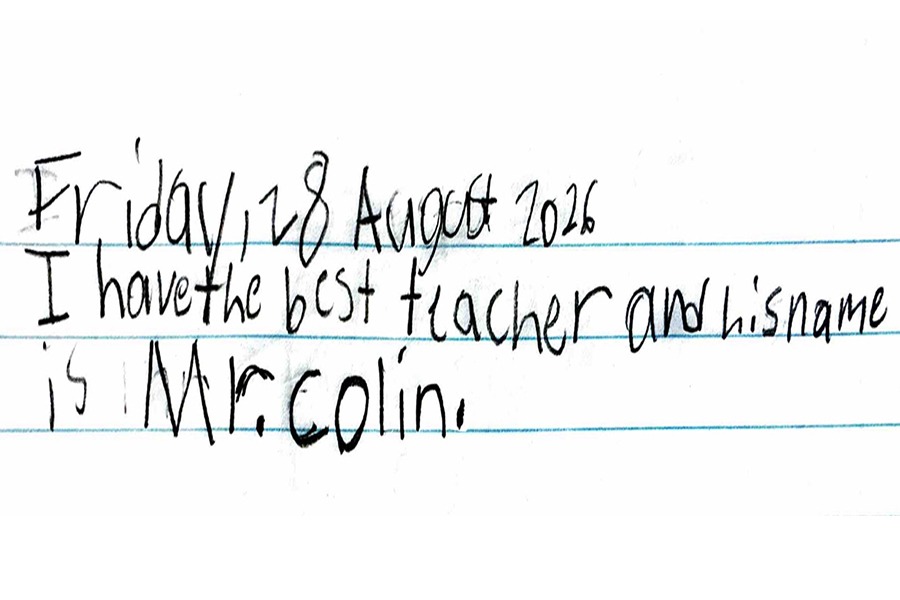
And then I reached the final page. Beneath the date, and written in big letters, there was only one sentence: “I have the best teacher,” she wrote, “and his name is Mr. Colin.” I smiled and placed the journal back inside her desk. My eyes watered, but I did not let the tears fall. No, Clem wouldn’t have wanted that.
About a month later, I received a records request from another school about an hour’s drive away. I knew what this meant: Clem had found a family, or maybe it had found her. As I went back through all of her paperwork, making sure everything was up to date, I came across the note her mother had written. Three words for Clementine, it had said. Manipulative, passive aggressive, and dont turn ur back. Keep an eye out for ur safety. I shook my head, wadded up the paper, and tossed it into the trash.
That was not the Clementine I knew.
Today, I pray Clementine settles into a new home with parents who allow her light to shine bright. I pray Clementine finds friends who laugh at her corny jokes and feel the warmth of her smile. I pray Clementine nurtures Frank, because he needs her just as much as she needs him. And I pray that, every morning as she enters her classroom, Clementine’s new teacher pats her on the shoulder, smiles at her, and says, “I am so glad you’re here.”
Because in Clementine’s world, kindness is the rule.
0 Comments Add a Comment?