
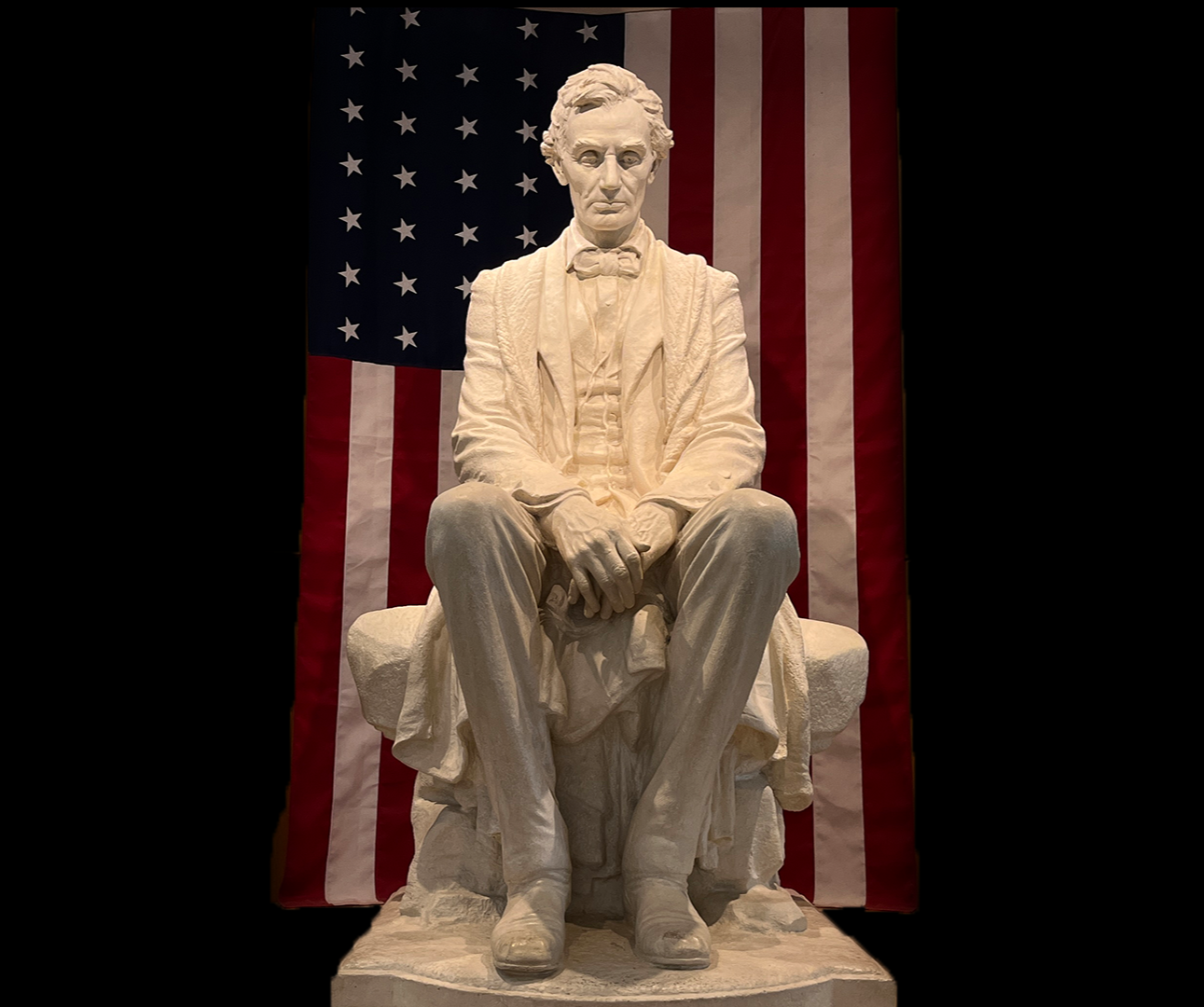
Man, Myth, Lincoln: A Portrait of a President at a Historic and Emotional Crossroads
Deep within the Caucasus mountains, where “[the] fingers of civilization had never reached,” somehow, as if by a miracle, an indigenous tribe knew the name of Abraham Lincoln. Renowned Russian author Leo Tolstoy recounted the time he once visited this tribe—the Circassians—and how he captivated them with stories about the world’s greatest heroes. Eventually, the Circassians wanted to know of a mysterious American man named Lincoln. Tolstoy told them everything he knew, especially that Lincoln “lived such a simple life,” even though he had “already become a legend” in many parts of the world. Satisfied with this story, the Circassians then wanted to see a photograph of this peculiar man. The next day, Tolstoy secured one and shared it with a tribesman. With a “trembling of his hands,” the Circassian man “gazed [at the image] for several minutes silently, like one in a reverent prayer.” The man began to cry, then said, “Don’t you find, judging from his picture, that his eyes are full of tears and that his lips are sad with a secret sorrow?”1
While that picture may have appeared puzzling for the tribesman, for historians, it’s no secret that Abraham Lincoln was prone to sadness. His former law partner and later biographer William Herndon said about Lincoln that “melancholy dripped from him as he walked.”2 Often reticent in private matters, Lincoln was actually “quite open in showing his true emotional self,” so that anyone “who watched [him] rarely came away thinking they knew his secrets, but . . . often came away thinking they’d seen the man.”3 Thus, a mere glance at Lincoln—as had the Circassian man with the picture—revealed the depths of his tortured soul, one stamped with tragedy and suffering. Lincoln was fully aware that his pain “had to be acknowledged and tolerated,” knowing, for instance, that one could not bask in joy without first wallowing in pity. As we will soon discover, “The same progression can be seen in his presidency.”4
Lincoln’s presidency, then, can best be understood by the convergence, or crossroads, of two very human crises: first, the intimate weight of personal grief, and second, the existential weight of a national conflict. At such a juncture, we are met with this question: How did President Lincoln navigate and balance his private agony with the nation’s demands throughout the Civil War? Was it this balancing act by which we remember his greatness?
“We love to think of the Great as flawless,” wrote W.E.B. Du Bois, the vocal civil rights activist and staunch Lincoln critic.5 Attorney General Edward Bates, who was in Lincoln’s Cabinet, certainly thought so, once saying of Lincoln that he “comes very near [to] being a perfect man.”6 To place Lincoln on such a pedestal, though, does a great disservice to his personal humanity. “The importance of Lincoln, as is the importance of any historical figure,” says professor of history Edna Greene Medford, “is for us to understand exactly who they were, in all of their complexity.”7 Thanks to the plethora of sources (especially primary documents) existing on Lincoln, we find, almost with relief, that he was not without foibles or flaws. Examining Lincoln through this lens—as an ordinary human being—we get a better glimpse of how extraordinary he was in leading the nation during his presidency.
Still, history prefers to remember Lincoln as more of a perfect divine figure than an imperfect human being. Since his death in 1865, his name has been “worshipped throughout the world.”8 Ralph Waldo Emerson said in the President’s eulogy that without print technology, he “would have become mythological.”9 However, the opposite seems to be true, for despite being the most documented president in American history, in the decades following his death, Lincoln became apotheosized—elevated from the rank of man to the rank of god. This veneration is evident in the countless works of art depicting him, portraits of a life “full of appeals to the imagination” whose “dramatic quality absorbs attention.”10
In fact, “Many painters, sculptors, poets, and orators have been indebted to Abraham Lincoln for the inspiration which has contributed” to each of the interpretations of his character.11 Walt Whitman’s poem “O Captain! My Captain!” revered Lincoln as a sailor who brought his ship safely to shore—an allusion for his leadership bringing about the end of the Civil War. In the 1880s, sculptor Augustus Saint-Gaudens constructed his Standing Lincoln statue in Chicago, capturing Lincoln’s humanity while proclaiming his immortality: “Monuments are put up for all ages,” he said, “while men and ages pass away.”12 Novels and film adaptations have since taken poetic license to Lincoln’s story, transforming his humble origins into a series of wholesome folktales—while other projects veer into ironic territory, like portraying Lincoln as a vampire hunter. And across the country, hundreds of Lincoln impersonators breathe life into his character, donning his signature top-hat and bow-tie, often departing from reality and arriving at caricature. There is nothing inherently wrong or immoral in “admiring Lincoln’s spirit.” Yet, in doing so, “we risk lionizing him as a man,” a danger to which threatens our shared human connection.13
Obviously, there is great might and vitality in Lincoln’s story. However, “Given the power of the Lincoln legend,” historian William Lee Miller urges us to remember Lincoln as “an actual human being with human limitations.”14 At first, this comment appears patronizing, as if to diminish Lincoln’s character. But if we take a step back and analyze him through the lens of his humanity, we find that he was indeed a very complicated man.
Earlier, when Bates called Lincoln “a perfect man,” he still recognized, however, that Lincoln lacked “but one thing . . . the element of will.”15 What exactly Bates meant about a “lack of will” is unclear, but with a basic understanding of Lincoln, we can assume Bates was referring to Lincoln’s often vulnerable temperament—more specifically, his deeply rooted feelings of doubt and worthlessness.
Even before he was elected president, Lincoln was unsure of his capabilities as the nation’s leader. In 1859, editor Thomas Pickett invited Lincoln to discuss “political matters, as to the policy of announcing [his] name for the presidency.” Lincoln replied that he could not visit, saying he felt “flattered and gratified that some partial friends think of me in that connection” to become president. But, Lincoln continued, “I must in candor say I do not think myself fit for the presidency.”16
Some scholars concur, saying that even though Lincoln is admired in hindsight, “he was, until he entered the White House, simply a lawyer from Springfield, Illinois—a man of great undeveloped capacities and narrowly limited background. He was far more fit to become [President] than to be President” (emphasis mine).17 Of this statement, Lincoln himself might have agreed, for in the first days of his presidency, he was still filled with more doubt than confidence. “Well boys,” he told a group of zealous journalists and reporters, “your troubles are over, but mine have just begun.”18 Seven rebellious states had already seceded from the Union, later establishing a new government called the Confederate States of America. Not more than two months later, in April, the Confederacy bombed Fort Sumter in South Carolina, and thus the Civil War began.19
Right away, Lincoln felt the weight of this new crisis. “Early in the war, he wondered aloud why anyone would want to be president,” telling a friend “that he sometimes thought his only escape would be to hang himself from a tree.”20 Not long after, Lincoln quipped that he was now “in the Garden of Gethsemane”—the exalted location where Jesus prayed before His crucifixion—continuing to say that “my cup of bitterness is full and overflowing.”21 There are interesting parallels to Lincoln’s comment and that of Jesus’s circumstance. When Jesus led His disciples to the garden to pray, He “became anguished and distressed,” adding that His “soul [was] crushed with grief to the point of death.”22 At that point, Jesus was fully aware He was going to the cross, the place of his brutal execution—no question about it. As for Lincoln, however, “The tremendous question for him to decide was whether his country should survive the crisis and flourish, or be dismembered and perish.”23 Did he, like Jesus, foresee a similar fate? Likewise, would the nation, like Jesus, confront a merciless death?
It didn’t take long for the war to develop into more than just a national crisis for Lincoln. It quickly became personal, for “the first celebrated death of the conflict was one of Lincoln’s close friends,” a Union officer named Elmer Ellsworth.24 Lincoln and Ellsworth had been acquainted for only a couple years before the latter’s death, but, in such a short time, the two had grown fond of each other. “Ever since the beginning of our acquaintance,” Lincoln wrote in a letter to Ellsworth, “I have valued you highly as a person[al] friend.” Back in Springfield, where Lincoln practiced law, the young and exuberant Ellsworth had helped with Lincoln’s presidential campaign, giving speeches “to rally the state’s citizens behind” him. When Lincoln won the election, and at his own request, it was Ellsworth who served as the President’s private security on the trip from Springfield to Washington. Ellsworth had even spent personal time at the White House with the presidential family, sometimes watching over Lincoln’s two boys, Willie and Tad. Naturally, “Lincoln considered Ellsworth a surrogate son.”25 Soon, however, grief would mark Lincoln as he mourned the loss of the man he viewed as family.
As soon as the war began, Ellsworth, who was always enthusiastic about the military, hastened to recruit men from New York City to serve the country in his Zouave regiment. A month later, Ellsworth and his men were called upon to force the Confederates to retreat out of Alexandria, Virginia—a city just across the Potomac River from the White House. To celebrate Virginia’s recent secession from the Union, rebel sympathizers in the city raised Confederate flags atop their buildings, most notably at the Marshall House, a hotel on Alexandria’s King Street. The flag was big enough that it could be seen by Lincoln with a spyglass from the White House, and it became “a symbol for the administration’s slowness to move against the gathering forces of the Confederacy.”26 So, when the Zouave regiment entered the city and spotted the secessionist banner at the Marshall House, Ellsworth’s “boyish pride . . . had trumped military prudence. If he was going to have this trophy, he would cut it down with his own hands.”27
And so he did. Reaching the rooftop with a few of his men, Ellsworth removed the flag from its staff, then “draped [it] around his shoulders . . . as they descended” the stairs.28 But, as they turned a corner, the hotel’s innkeeper, James Jackson, aimed his shotgun at Ellsworth’s heart and fired at point-blank range. Seconds later, one of Ellsworth’s men retaliated, killing Jackson with a direct shot to the forehead.29 In an instant, Ellsworth and Jackson, two sworn enemies, were united as they “lay dead on the staircase, their blood pooling across the dusty boards . . . [and] seeping into the folds of the fallen flag.”30
Ellsworth’s death may not have been the exact first of the war, but his was indeed the first death that touched the nation—and its president. The morning after the incident, two visitors on a matter of business disrupted Lincoln’s contemplation. They witnessed Lincoln “so overcome with grief that he was unable to hold back tears.”31 Turning around to face them, Lincoln said, “I will make no apology, gentlemen, for my weakness; but I knew poor Ellsworth well, and held him in great regard.”32 Later, he shared his sympathy in a letter to Ellsworth’s parents:
My dear Sir and Madam,
In the untimely loss of your noble son, our affliction here is scarcely less than your own. So much of promised usefulness to one’s country . . . have rarely been so suddenly dashed, as in his fall. . . . The honors he labored for so laudably, and, in the sad end, so gallantly gave his life, he meant for them, no less than for himself. . . . May God give you that consolation which is beyond all earthly power.
Sincerely your friend in a common affliction,
A. Lincoln33
On the day of the funeral, Ellsworth’s open casket lay in the East Room of the White House. When it was Lincoln’s turn to view Ellsworth’s body, he cried, saying, “My boy! My boy! Was it necessary this sacrifice should be made?”34 Ellsworth’s death blurred the lines between Lincoln’s private agony and his executive duties, forcing him to recognize the true cost of the war. This profound grief propelled him to find purpose in the nation’s destruction.
For Lincoln, Ellsworth was an immense loss. But for the nation, “Ellsworth’s death became the lightning rod for recruitment that Lincoln had been looking for.”35 Nearly 200,000 men enlisted for the Union effort in the month following Ellsworth’s murder.36 Yet, with the numerical strength of the Union army, the Confederacy still seemed to gain the upper hand. In July, a string of Union losses “dashed hopes for a quick end to the conflict.” Following Confederate victories at battles in Missouri and Virginia, “Lincoln called for the enlistment of 500,000 men, which he doubled three days later.”37 One of those men was U.S. Senator Edward Baker, a longtime friend of the Lincoln family and the namesake of their second child, Eddy.38
After the war broke out, Senator Baker sought to serve his country another way, this time as a colonel for the Army of the Potomac. That autumn, Colonel Baker marched with his militia into Virginia and reached a steep ridge named Ball’s Bluff. As they climbed up the cliff, the already-stationed Confederates rained fire upon the Union army, resulting in casualties for half their force. Among the fallen was Colonel Baker, who was struck by a bullet to the head.39
Lincoln’s reaction to Baker’s death mirrored his reaction to Ellsworth’s. While waiting for an interview with General McClellan at his headquarters, journalist Charles Coffin caught a glimpse of the President, who had just learned of Colonel Baker’s death. Coffin saw Lincoln staggering out of the office with “his head bowed upon his breast, [and] his hands clasped to his heart.” Coffin was stunned by the President’s open display of grief: “Never before had I seen such anguish on a human countenance as upon his face.”40 This was an image of the President in distress—but it was also a portrait of a man in mourning.
In less than six months, President Lincoln lost two of his closest friends to a war for which it was his duty to cease. Now, he carried “not only the burden of the nation, but [also his] unspeakable private grief.”41 With the nation “full of sorrow,” wrote Elizabeth Keckley, Mary Lincoln’s dressmaker and confidante, “there could not be much gaiety at the capital.”42 However, despite the misery thrust upon him, Lincoln kept his resolve. In his first message to Congress in December, he highlighted the grim progress of the war, but also hinted at his personal optimism: “The struggle of to-day,” he concluded in his speech, “is not altogether for to-day; it is for a vast future also. With a reliance on Providence all the more firm and earnest, let us proceed in the great task which events have devolved upon us.”43 Yet, by the new year, Lincoln was met “with the weaknesses and perversities of human nature at home,” as the war’s impact finally reached the inside of the White House.44
To be clear, there were no violent skirmishes at the White House. Instead, the real threat inside the mansion was its drinkable water. During the war, the Potomac River had become contaminated by human and animal waste from camps along its banks. And with the river being the White House’s primary source for consuming drinkable water, Lincoln’s two boys eventually came down with suspected typhoid fever.45 Tad, the youngest son, made an expedient recovery. But by February, Willie’s condition worsened.
On the night of an extravagant party hosted by the Lincolns, Willie laid in bed upstairs and could hear the faint sounds of the Marine Band performing at the reception downstairs. Spirits were high amongst the partygoers—except for both Mary and Abe, who excused themselves from the party throughout the night to check up on their sick boy. There is no definite way to determine what Abe was thinking or feeling, but Elizabeth Keckley, who also took care of sick Willie, recalled how the President stood “with his back to the fire, his hands behind him, and his eyes on the carpet,” and wore “a thoughtful, solemn look.” Fortunately, Willie survived through the night, but just two weeks later, after entering into a coma, “God called the beautiful spirit home, and the house of joy was turned into the house of mourning.”46
As Keckley finished preparing Willie’s body for his casket, she observed Lincoln weeping over his deceased child. “My poor boy,” he said, as he uncovered a sheet from the face of his son, “he was too good for this earth. God has called him home. I know that he is much better off in heaven, but then we loved him so. It is hard, hard to have him die!” Keckley also noticed how Lincoln’s “tall frame was convulsed with emotion,” and how, like other descriptions of Lincoln’s sorrow, she “never saw a man so bowed down with grief.”47
At the funeral in the East Room of the White House, which was adorned with black mourning drapery, dignitaries and citizens paid their condolences to Willie and the Lincoln family. Nathaniel Parker Willis, a popular writer in attendance, observed Lincoln sitting “with a burden on his brain,” adding that he was “bent now with [a] load at both heart and brain.” No doubt, Willis was acknowledging the reality of the President’s dual burdens: first, as a father in mourning; and second, as a President in crisis. At this crossroads, Lincoln was forced to reconcile both his heart and his head. “That God may give him strength for all his burdens,” Willis concluded, “is, I am sure, at present the prayer of a nation.”48
To gather such fortitude, Lincoln needed a place to sort through his grief and to develop an unwavering determination. Thus, just a few miles north of the capital, at a nearly three hundred acre refuge for disabled veterans called the Soldiers’ Home, Lincoln found respite. Away from the political and emotional turmoil which engulfed them at the White House, the Lincoln family settled on the property inside a charming, two-story cottage. There, from summer through autumn, the President traveled every morning to the White House, and then retired in the evenings to his idyllic retreat, where he would relax and engage in social activities like storytelling.49
Despite his seclusion, however, Lincoln was still surrounded with reminders of his life’s greatest burden. On pathways next to the cottage, Lincoln saw crippled soldiers hobbling along. From outside his upstairs window, he watched as fresh graves filled up a new national cemetery. Cannon fire could be heard in the distance, and so could the wagons of various military personnel passing by on adjacent roads.50 Granted, the cottage wasn’t the perfect escape for Lincoln, but it did provide him with the space away from his work to process his emotions.
At times, though, Lincoln’s temperament was pushed beyond its normal limits. It was rare that he received a continual break, so when constant visitors disrupted his peace to seek “favors or some special audience with the president,” his distress grew more intense.51 On a late summer weekend, for example, while expecting “a quiet Sabbath, [so] that he might gather some strength for the coming week,” Lincoln reached a breaking point. His downtime was interrupted by two men who were eager for the President’s help. When the guests Colonel Charles Scott and his friend John French were invited indoors, they saw the President completely relaxed, “reposed in a broad chair, one leg hanging over its arm,” and absorbed in his own thoughts.52 Then Lincoln listened as Colonel Scott made his plea.
Scott mentioned how his wife had been involved in a recent steamer collision on the Potomac River, saying that she (among a dozen others) had sadly drowned. When her body was found by locals, Scott wanted to retrieve his deceased wife and bury her in their home state of New Hampshire. In order to do so, however, he would risk entering into a war zone, and he first had to obtain special permission from Secretary of War Edwin Stanton—but Stanton refused. So, in search of an appeal, Scott rushed to the White House only to find that the President had already departed to his cottage.53 And now, on that late Saturday afternoon, Scott stood in the presence of the one man who could carry out his desperate wishes.
But Lincoln’s response was shocking.
“Am I to have no rest?” the President said in annoyance as he stood up from his chair. “Is there no hour or spot when or where I may escape this constant call?” He questioned why Scott hadn’t first gone to the war office, then criticized him for having instead come to the cottage. Lincoln said it would be wrong and irresponsible to overrule Stanton’s orders, saying it might interfere with other war developments. Finally, after being bent so far, Lincoln snapped:
Why do you come here to appeal to my humanity? Don’t you know, Colonel Scott, that we are in the midst of war? That suffering and death press upon all of us? . . . At any rate, you must not vex me with your family troubles. Why, every family in the land is crushed with sorrow; but they must not each come to me for help. I have all the burden I can carry.54
This reply was uncharacteristic for Lincoln, and it appears that he, too, recognized this. (Later, he confessed to having “had a regretful night.”) The next morning, Colonel Scott awoke to a knock at his hotel door. It was President Lincoln. He grabbed Scott by the shoulders and exclaimed, “My dear colonel, I was a brute last night. I have no excuse for my conduct. Indeed, I was weary to the last extent, but I had no right to treat a man with rudeness who had offered his life for his country, much more a man who came to me in great affliction.” He continued by honoring the memory of Scott’s wife, then added: “Now, my good man, hurry and get ready.” Waste no time, the President told him, for he had arranged to have a boat carry Scott down the river to recover his wife’s body. “And, colonel,” Lincoln finished, “when you get home, don’t tell your children of my conduct last night.” At the wharf, President Lincoln watched as Colonel Scott’s boat departed, and then journeyed back to his cottage for breakfast.55
As the war escalated, so did Lincoln’s agony. In December 1862, after the Battle of Fredericksburg (a Union defeat), Lincoln remarked, “If there is a worse place than Hell, I am in it.”56 Around the same time, Confederate forces threatened to invade the capital and initiate a coup upon the government, while Republican congressmen condemned the President for the war and expressed their wishes for him to resign. At the White House, Senator Orville Browning found Lincoln in extreme despair. “We are now on the brink of destruction,” Lincoln told him. “It appears to me the Almighty is against us, and I can hardly see a ray of hope.”57
It was the winter of Lincoln’s discontent—a fitting phrase for this metaphorical season of cold and bitter darkness, and also part of the opening words to Shakespeare’s Richard III, one of Lincoln’s favorite dramas.58 Yet, as poet Percy Shelley once asked, “If Winter comes, can Spring be far behind?”59 Lincoln’s presidency was indeed darkened with suffering and despair, but brighter days were surely ahead for him. First, however, he had to figure out how to preserve the Union and to end the war.
To accomplish this, Lincoln was forced to overcome his greatest executive obstacle: the issue of slavery. At the beginning of his presidency, he said that he had “no purpose, directly or indirectly, to interfere with slavery in the states where it exists,” making clear that it would be unlawful for him to pursue.60 He wanted first to unite the country, hoping slavery would soon dissolve on its own. As the war lingered on, though, and after much careful deliberation, he eventually decided “that it was [necessary] for the salvation of the Union, that we must free the slaves or be ourselves subdued.”61 Here, Lincoln reached a turning point in his presidency.
Throughout the summer of 1862, Lincoln quietly drafted a proclamation that would effectively grant freedom to all slaves in rebellious states. By July, Lincoln revealed at a cabinet meeting that he was “profoundly concerned” about the war’s progression, and thus “had determined to take some definitive steps” toward the emancipation of slaves. Lincoln knew his Cabinet had differing opinions on the subject, but he “had not called them together to ask their advice.”62 He had already made up his mind. “I can only trust in God I have made no mistake,” he said to a cheering crowd after he published a preliminary draft. “It is now for the country and the world to pass judgment on it.”63 At the crossroads of a personal and a public existential crisis, Lincoln made a turn down the path of deliverance.
In January, when President Lincoln prepared to issue the Emancipation Proclamation, he finally grasped the confidence he had been striving for his entire life. “I [have] never,” he noted as he lifted his pen to the document, “felt more certain that I was doing right, than I do in signing this paper.”64 Not only did this decree solidify Lincoln’s legacy as a great president, but it also transformed his prolonged suffering into meaning. “I believe that in this measure,” he told an old friend from Springfield regarding the proclamation, “my fondest hopes will be realized.”65
Two years later, in April 1865, his fondest hopes were, in fact, realized. On Good Friday, a few days after General Lee surrendered at Appomattox Courthouse, thereby ending the war, President Lincoln was in unusually high spirits. “Didn’t our Chief look grand today!” said Edwin Stanton at the end of that morning’s cabinet meeting. Others also took note of how Lincoln’s typical sorrow gave way to joy, “as if conscious of the fact that the great purpose of his life had been achieved.” That afternoon, on a quiet carriage ride, Mary Lincoln drew attention to her husband’s glee, saying, “You almost startle me by your great cheerfulness.” Abraham replied that, because the war had ended, “I have never felt better in my life.” Around dinner, Lincoln read stories to some friends before heading to Ford’s Theatre to catch an evening show.66
It was indeed a good Friday.
As fate would have it, though, Lincoln did not get to relish any further joy. By dying a tragic death that night “by the red hand of violence,” he became, as Frederick Douglass said, “doubly dear to us, and his memory will be precious forever.”67 Instantly, Lincoln’s likeness underwent a transfiguration, immortalizing him not as a man, but as a divine hero. It’s important, however, that we remember Lincoln “not [only] for what he did as chief executive of the nation,” Booker T. Washington suggested, “but for what he did as a man.”68 Our eternal admiration for Lincoln echoes W.E.B. Du Bois’s sentiment that we “love him not because he was perfect, but because he was not.”69 Altogether, we discover that Lincoln was a man cut from the same American cloth: a supreme testament of who we are and what we can aspire to be.
Footnotes
- Leo Tolstoy, "Tolstoi Holds Lincoln World's Greatest Hero," interview by Count S. Stakelberg, New York World, February 7, 1909, reprinted in The Lincoln Anthology: Great Writers on His Life and Legacy from 1860 to Now, ed. Harold Holzer (New York: Library of America, 2009), 388-389.
- Joshua Wolf Shenk, Lincoln's Melancholy: How Depression Challenged a President and Fueled His Greatness (Mariner Books, 2006), 4.
- Shenk, Lincoln's Melancholy, 133.
- Shenk, Lincoln's Melancholy, 189.
- W.E.B. Du Bois, "Again, Lincoln," The Crisis 24, no. 5 (Sept. 1922): 199.
- Doris Kearns Goodwin, Team of Rivals: The Political Genius of Abraham Lincoln (Simon & Schuster, 2005), 675.
- Edna Greene Medford, "Abraham Lincoln's Evolving Views on Slavery," interview by Jackie Olive and Barak Goodman, July 11, 2022, 03:06:45, https://www.youtube.com/watch?v=Zu2mFQjBUNo.
- Tolstoy, "Tolstoi Holds Lincoln World's Greatest Hero," interview by Count S. Stakelberg, 389.
- Shenk, Lincoln's Melancholy, 217.
- Elihu Root, "Lincoln as a Leader of Men," August 28, 1920, in The American Journal of International Law 14, no. 4 (1920): 590, https://teachingamericanhistory.org/document/lincoln-as-a-leader-of-men/.
- Louis A. Warren, "Theodore Roosevelt's Admiration for Lincoln," Lincoln Lore, no. 1004 (July 5, 1948), https://www.friendsofthelincolncollection.org/wp-content/uploads/2018/09/LL_1948-07-05_01.pdf.
- Augustus Saint-Gaudens, A Legacy in Stone, n.d., Quote, n.d., Ford's Theater, Washington, D.C.
- Shenk, Lincoln's Melancholy, 209.
- William Lee Miller, President Lincoln: The Duty of a Statesman (New York: Alfred A. Knopf, 2007), 40.
- Goodwin, Team of Rivals, 675.
- Charles L. Wilson, "Representative Men," The Midland Monthly 5, no. 1 (Jan. 1896): 515-17.
- David M. Potter, Lincoln and His Party in the Secession Crisis (LSU Press, 1993), 315.
- Shenk, Lincoln's Melancholy, 170.
- Doris Kearns Goodwin, Leadership: In Turbulent Times, 211.
- Shenk, Lincoln's Melancholy, 178.
- Shenk, Lincoln's Melancholy, 171.
- Matthew 26:36-38 (New Living Translation).
- Frederick Douglass, "An Oration in Memory of Abraham Lincoln," in Negro Orators and Their Orations, ed. Carter Godwin Woodson (Washington, DC: Associated Publishers, 1925), 525.
- Shenk, Lincoln's Melancholy, 176.
- Adam Stauffer, "'The Fall of a Sparrow': The (Un)timely Death of Elmer Ellsworth and the Coming of the Civil War," The Gettysburg College Journal of the Civil War Era 1 (2010): 46-47.
- Adam Goodheart, 1861: The Civil War Awakening (Alfred A. Knopf, 2008), 274, 279.
- Goodheart, 1861, 284.
- Goodheart, 1861, 285.
- Stauffer, "Fall of a Sparrow," 44.
- Goodheart, 1861, 285.
- Stauffer, "Fall of a Sparrow," 48.
- Goodheart, 1861, 290.
- Abraham Lincoln to Ephraim D. and Phoebe Ellsworth, May 25, 1861, in The Collected Works of Abraham Lincoln, ed. Roy P. Basler et al. (New Brunswick, NJ: Rutgers University Press, 1953), 4:385-86.
- Goodheart, 1861, 291.
- Stauffer, "Fall of a Sparrow," 51.
- Goodheart, 1861: The Civil War Awakening, 286.
- Shenk, Lincoln's Melancholy, 177.
- "Edward Baker Lincoln: Lincoln Home National Historic Site," U.S. National Park Service, April 10, 2015, https://home.nps.gov/liho/learn/historyculture/edwardlincoln.htm.
- Shenk, Lincoln's Melancholy, 177.
- Charles Carleton Coffin, Life of Abraham Lincoln (Harper & Brothers, 1893), 279.
- Coffin, Life of Abraham Lincoln, 278-279.
- Elizabeth Keckley, "Willie Lincoln's Death-Bed," in Behind the Scenes: Thirty Years a Slave and Four Years in the White House (London, England: Partridge and Oakey, 1868), 41.
- Abraham Lincoln, "First Annual Message," Miller Center, Dec. 3, 1861, https://millercenter.org/the-presidency/presidential-speeches/december-3-1861-first-annual-message.
- Root, "Lincoln as a Leader of Men."
- Shenk, Lincoln's Melancholy, 177.
- Keckley, "Willie Lincoln's Death-Bed," 45.
- Keckley, "Willie Lincoln's Death-Bed," 46.
- Nathaniel Parker Willis, quoted in Keckley, "Willie Lincoln's Death-Bed," 48-49.
- Matthew Pinsker, Lincoln's Sanctuary: Abraham Lincoln and the Soldiers' Home (Oxford University Press, 2003), 2, 9.
- Pinsker, Lincoln's Sanctuary, 4, 78.
- Pinsker, Lincoln's Sanctuary, 77.
- John French, "Reminiscences of Famous Americans," North American Review 141 (Sept. 1885): 239.
- Pinsker, Lincoln's Sanctuary, 52.
- French, "Reminiscences of Famous Americans," 240.
- French, "Reminiscences of Famous Americans," 241.
- Goodwin, Leadership, 228.
- Shenk, Lincoln's Melancholy, 187.
- Miller, The Duty of a Statesman, 224.
- Percy Shelley, "Ode to the West Wind," 1819, https://poets.org/poem/ode-west-wind.
- Miller, The Duty of a Statesman, 255.
- Gideon Welles, quoted in Shenk, Lincoln's Melancholy, 185.
- F. B. Carpenter, The Inner Life of Abraham Lincoln: Six Months at the White House (New York: Hurd and Houghton, 1868), 21.
- Goodwin, Team of Rivals, 482.
- Goodwin, Team of Rivals, 499.
- Miller, The Duty of a Statesman, 39.
- Goodwin, Leadership, 365-366.
- Douglass, "An Oration in Memory of Abraham Lincoln," 527.
- Booker T. Washington, "An Address on Abraham Lincoln," https://teachingamericanhistory.org/document/an-address-on-abraham-lincoln/.
- Du Bois, "Again, Lincoln," 200.
Bibliography
Carpenter, F. B. The Inner Life of Abraham Lincoln: Six Months at the White House. New York: Hurd and Houghton, 1868.
Coffin, Charles Carleton. Abraham Lincoln. Harper & Brothers, 1893.
Douglass, Frederick. “An Oration in Memory of Abraham Lincoln.” In Negro Orators and Their Orations, edited by Carter Godwin Woodson, 516–29. Washington, DC: Associated Publishers, 1925.
Du Bois, W.E.B. “Again, Lincoln.” The Crisis 24, no. 5 (September 1922): 199–201.
French, John R. “Reminiscences of Famous Americans.” North American Review 141 (September 1885): 237–39.
Goodheart, Adam. 1861: The Civil War Awakening. Alfred A. Knopf, 2008.
Goodwin, Doris Kearns. Leadership: In Turbulent Times. Simon & Schuster, 2019.
———. Team of Rivals: The Political Genius of Abraham Lincoln. Simon & Schuster, 2005.
Keckley, Elizabeth. “Willie Lincoln’s Death-Bed.” In Behind the Scenes: Thirty Years a Slave and Four Years in the White House. London, England: Partridge and Oakey, 1868.
Lincoln, Abraham. Abraham Lincoln to Ephraim D. and Phoebe Ellsworth, May 25, 1861. In The Collected Works of Abraham Lincoln, edited by Roy P. Basler, Marion Dolores Pratt, and Lloyd A. Dunlap, 4:385–86. New Brunswick, NJ: Rutgers University Press, 1953.
———. “First Annual Message.” Miller Center, December 3, 1861. https://millercenter.org/the-presidency/presidential-speeches/
december-3-1861-first-annual-message.
Medford, Edna Greene. “Abraham Lincoln’s Evolving Views on Slavery.” Interview by Jackie Olive and Barak Goodman. Uploaded by Life Stories, YouTube, July 11, 2022.
Miller, William Lee. President Lincoln: The Duty of a Statesman. New York: Alfred A. Knopf, 2007.
Pinsker, Matthew. Lincoln’s Sanctuary: Abraham Lincoln and the Soldiers’ Home. Oxford University Press, 2003.
Potter, David M. Lincoln and His Party in the Secession Crisis. LSU Press, 1993.
Root, Elihu. “Lincoln as a Leader of Men.” August 28, 1920. Reprinted in The American Journal of International Law 14, no. 4 (1920): 590–93. https://teachingamericanhistory.org/
document/lincoln-as-a-leader-of-men/.
Saint-Gaudens, Augustus. A Legacy in Stone. n.d. Quote. Ford’s Theater. Washington, D.C.
Shelley, Percy. “Ode to the West Wind.” Poets.org, 1819. https://poets.org/poem/ode-west-wind.
Shenk, Joshua Wolf. Lincoln’s Melancholy: How Depression Challenged a President and Fueled His Greatness. Mariner Books, 2006.
Stauffer, Adam. “‘The Fall of a Sparrow’: The (Un)timely Death of Elmer Ellsworth and the Coming of the Civil War.” The Gettysburg College Journal of the Civil War Era 1 (2010): 44–52.
Tolstoy, Leo. “Tolstoi Holds Lincoln World’s Greatest Hero.” Interview by Count S. Stakelberg. New York World, February 7, 1909. Reprinted in The Lincoln Anthology: Great Writers on His Life and Legacy from 1860 to Now, edited by Harold Holzer, 386–91. New York: Library of America, 2009.
U.S. National Park Service. “Edward Baker Lincoln: Lincoln Home National Historic Site,” April 10, 2015. https://home.nps.gov/liho/learn/historyculture/edwardlincoln.htm.
Warren, Louis A. “Theodore Roosevelt’s Admiration for Lincoln.” Lincoln Lore, no. 1004 (July 5, 1948). https://www.friendsofthelincolncollection.org/wp-content/uploads/2018/09/
LL_1948-07-05_01.pdf.
Washington, Booker T. “An Address on Abraham Lincoln.” February 12, 1909. https://teachingamericanhistory.org/document/an-address-on-abraham-lincoln/.
Wilson, Charles L. “Representative Men.” The Midland Monthly 5, no. 1 (January 1896): 515–17.
1 Comment Add a Comment?
Tom Niemiller
Thank you for sharing this. You might like Thomas DiLorenzo's "The Real Lincoln" - It's a good read.